Learning Alongside Industry: Louise Kellerman on Building a Life in Design
With more than 25 years in design and nearly two decades building Design Assembly, Louise Kellerman has spent her career connecting people, ideas and the wider creative industry.
Now a Lecturer on the Bachelor of Media Design at Media Design School at Strayer (MDS), she brings those connections and experiences into the classroom, helping emerging designers understand not just how to create great work, but how to find their place in the industry.
From design student to industry connector
Louise’s path into design began at high school, where an interest in art led her to consider how creativity could become a career.
Once she began studying graphic design, she quickly realised the discipline offered something different.
“I realised it was about problem solving and creating things for people,” she says. “That was definitely a better fit for me than fine art as a career pathway.”
After graduating, Louise approached her first few years in the industry as another period of learning. She worked in magazine design before moving into an Auckland studio, then spent three years in London gaining experience across different creative environments.
Returning to Auckland in 2006 eventually led to a new direction. In 2008, Louise founded Design Assembly, initially through a series of evening speaker events created to fill what she saw as a gap in New Zealand’s graphic design industry.
“I felt there was no community specifically for graphic design,” she says. “I wanted to serve my particular community.”
Since then, Design Assembly has grown into an important part of Aotearoa’s design landscape, connecting designers through events, workshops, interviews and opportunities to share ideas and learn from one another.
Bringing industry into the classroom
That focus on connection now carries through to Louise’s teaching at MDS.
Alongside teaching, she continues to lead Design Assembly, keeping her closely connected with designers, studios and conversations happening across the profession.
For students, it means learning from someone whose perspective on design is informed by what is happening in the industry right now.
Louise also sees value in the opportunities students have to make their own connections. From live client briefs to industry portfolio reviews, the Bachelor of Media Design gives students experience engaging with professional practice while they study.
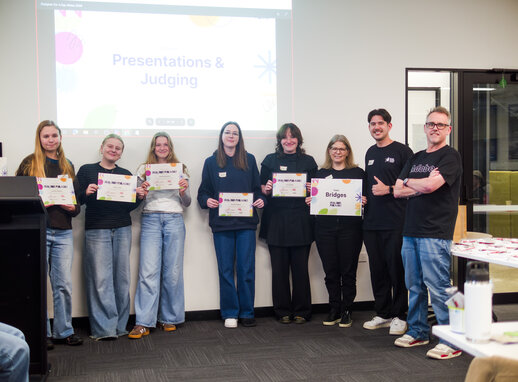
After a recent portfolio review at MDS, Louise saw that value first-hand.
“It was great to see so many from the industry come in, and they love it and the students love it,” she says. “That was invaluable.”
Her advice to students is to take that mindset beyond the classroom too.
“Get involved in your professional community of practice while you’re still a student,” she says. “Sometimes it’s just that someone remembers your face.”
What does the industry need from emerging designers?
After years spent connecting with studios and creative professionals through Design Assembly, Louise has seen the industry evolve through major technological and cultural shifts.
AI is the latest, but she sees change itself as nothing new for designers.
When Louise entered the industry, junior designers were often the ones expected to experiment with emerging digital technologies. Today’s graduates have a similar opportunity with AI.
She believes students should explore these tools and understand their possibilities, while developing the design knowledge needed to use them critically.
You’ve got to have an understanding still of design as a discipline, from the theoretical to the practical, so that you know what is good, what works.”
And the qualities that make an emerging designer stand out extend well beyond technical proficiency.
“Curiosity. Hunger. Passion. Willingness to learn, to take feedback, to be able to talk about design decisions,” Louise says.
Adaptability, communication and being prepared to ask questions matter too. They are skills students develop not only through their individual work, but through collaborating with others and responding to real-world briefs.
Finding your place in design
Louise’s own career is a reminder of just how many directions a design education can lead.
She has moved between studio practice, freelance work, community building, events and education, and continues to learn herself, currently undertaking postgraduate design study alongside teaching.
For students looking at an industry undergoing rapid change, her advice is to stay curious, adaptable and interested in the world beyond design.
“We live in a disrupted time, and we have done for many, many years,” she says.
A piece of advice from one of her own tutors has also stayed with her throughout her career.
“He said, ‘I’m not interested in how good designers are as they graduate. I’m interested in where people are in 10 years.’”
For Louise, that long-term perspective matters. Studying design is a chance to explore, develop your thinking, make connections and begin working out where your own interests and strengths might lead.
“There’s so much that you can do,” she says. “You can find your place under the umbrella of design with a capital D.”